Killeen, TX
Drainage Correction
Half of foundation problems start with bad drainage. If you don't fix the water, the foundation will move again.
Killeen, TX
Half of foundation problems start with bad drainage. If you don't fix the water, the foundation will move again.
Drainage is the half of foundation work that’s invisible. You can spend $10,000 on piers, but if water keeps soaking the soil under your slab, you’ll be back in 5-10 years.
We assess and fix the surface and subsurface water that drives foundation movement in Killeen and across Bell County.
Bad grade. The soil around your house should slope away at about 6 inches over the first 10 feet. Older Killeen lots often slope toward the foundation instead, sometimes from settlement and sometimes from years of landscaping additions. We regrade with new fill and reseed.
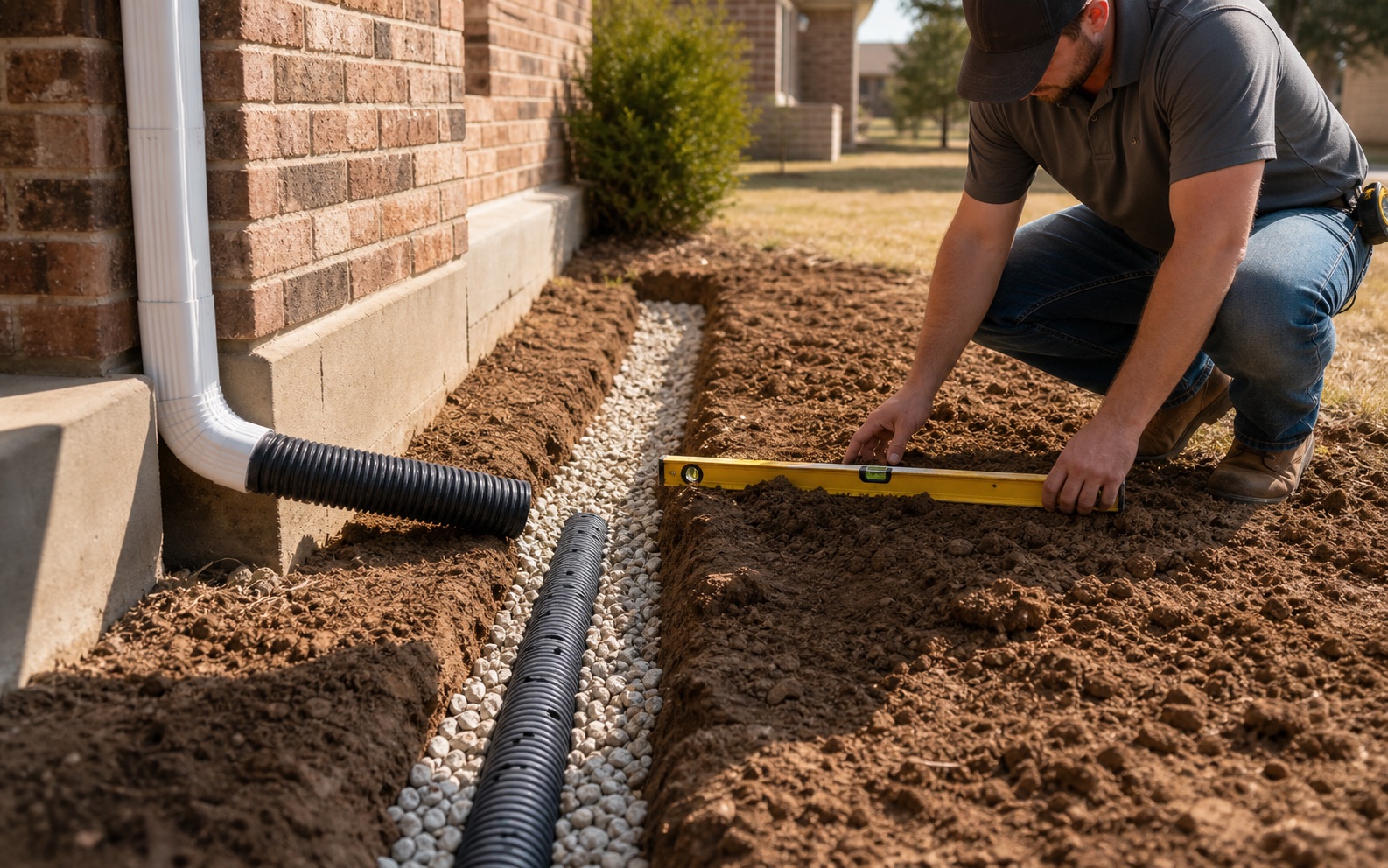
Downspouts that dump too close. Standard downspouts drop water within 2 feet of the foundation. We extend them 6-10 feet out with buried PVC, or convert to splash blocks where space allows.
French drains. Where surface grading isn’t enough (clay soil holds water rather than draining it), a French drain collects subsurface water and routes it away. It’s a perforated pipe in gravel. The perimeter type runs along the foundation. The area type collects from a low spot in the yard.
Surface drains. Catch basins in low spots, channel drains across driveways or patios. Connect to the same outlet as the French drain or to the street.
The Black Prairie clay under most Bell County homes is what’s called expansive soil. It absorbs water (swells) and loses water (shrinks) more than typical loam or sand. The bigger the moisture swing, the more the soil moves, and the more your foundation moves with it.
A house with good drainage sees relatively even soil moisture year-round. A house with bad drainage gets soaked in winter and bone-dry in summer, and the soil moves inches over a decade. Same lot, same house design. Totally different foundation outcomes.
Drainage work is usually done before or alongside foundation repair. Doing it after means you’ve fixed the symptom but not the cause. Call (254) 555-0123 to get the assessment. Most homes need some combination of the four fixes above, and a pro can tell you which after walking the perimeter.
We check grade, downspout placement, soil saturation, and surface flow patterns around the entire perimeter.
Some combination of regrading, French drains, downspout extensions, and surface drains.
Most drainage corrections take 1-3 days. Trenching is the bulk of the work.
We test with a hose or wait for the next rain to confirm water flows away from the home.
Tell us a bit about your project. We'll match you with a vetted local provider in Killeen and surrounding areas. No pressure, no spam.
(254) 555-0123Or fill out the form. We typically respond within one business hour.